Citation playbook
AI Citation Optimization: How to Get Cited by AI Answers
AI citation optimization is the practice of making useful pages easier for AI answer engines to discover, understand, and cite as sources. The goal is a verifiable source link in answers to real buyer questions.
Definition
Citation vs. mention: what is the difference?
A mention means the answer names your product or brand. A citation means the answer attaches a source URL. If ChatGPT says “Answerlume is one option” without a link, that is a mention. If Perplexity links to the Answerlume sample report as evidence, that is a citation. The two signals measure different outcomes and should be recorded separately.
A cited page is not always your homepage. Depending on the prompt, an engine may cite a comparison table, documentation, a glossary, original research, or a community discussion. That is why a useful citation strategy starts with the question and the evidence needed to answer it, not with a keyword repeated across every page.
Source selection
How do ChatGPT and Perplexity choose sources?
Both products can retrieve web pages and synthesize an answer from what they find, but their retrieval and presentation differ. A page is more useful as a candidate source when it is crawlable, directly addresses the question, and contains specific claims that can be checked against the page itself.
Read the existing engine-specific sections on ChatGPT Search and Perplexity for the broader mechanics. This page stays focused on the source-link side: making a page worth citing and measuring whether it was actually cited. For Google’s separate surface, see the AI Overviews section.
Execution
7 actionable steps for better AI citations
Apply this to one important buyer question at a time.
- Choose a real buyer prompt. Use a specific question such as “best AI visibility checker for an indie SaaS” rather than a broad category label.
- Inspect the current sources. Run the prompt on ChatGPT Search and Perplexity. Record which page types and URLs are cited instead of assuming a blog post is always the answer.
- Give the page one clear job. Answer the chosen question in the first two or three sentences. Keep definitions, comparisons, instructions, and evidence on separate pages when their intents differ.
- Make the evidence extractable. Use descriptive headings, compact paragraphs, tables for like-for-like facts, and dates for volatile information such as pricing.
- Verify every claim. Link to primary sources for external facts. For your own product, show real output or raw observations instead of an invented score or testimonial.
- Remove discovery barriers. Keep the canonical URL indexable, include it in your sitemap, allow relevant crawlers, and add descriptive internal links from existing pages.
- Re-run the same prompt set. Answers vary. Use repeated runs and compare citation frequency over time; do not treat one answer as a stable ranking.
Observed evidence
What a real AI citation looks like
A citation record needs the prompt, run, timestamp, answer, and source URLs—not just a percentage.
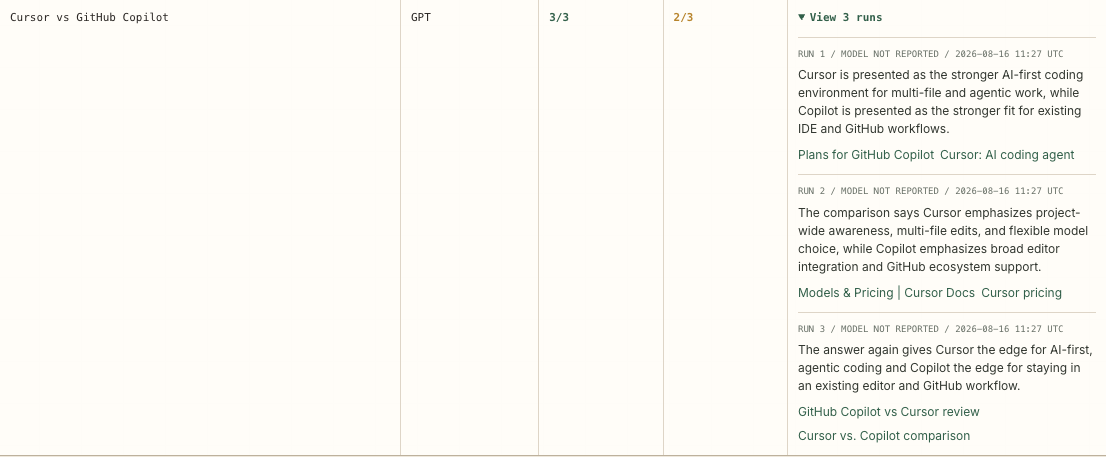
This example shows why mention and citation counts diverge. The prompt “Cursor vs GitHub Copilot” mentioned Cursor in all three ChatGPT Search runs, while two runs cited Cursor pages. A single visibility score would hide that distinction.
Measurement
How to measure citation progress
Start with five buyer-style prompts. Run each prompt three independent times on ChatGPT Search and Perplexity, producing 30 observations. Save every raw answer and cited URL, then calculate citation frequency as cited observations divided by all observations. Keep the prompt, engine, model detail when available, and timestamp attached to each row.
The Answerlume AI visibility checker performs that exact check and does not create a modeled visibility score. Each account gets three full checks; report links remain available for seven days. If you prefer to do it manually, follow the step-by-step AI visibility check.
Need a monitoring platform rather than an on-demand evidence check? Compare engine coverage, prompt allowances, and verified entry prices in the AI visibility tools guide.
FAQ
What is AI citation optimization?
AI citation optimization is the practice of making useful pages easier for AI answer engines to discover, understand, and cite as sources. It focuses on source links, not just brand mentions.
Is a brand mention the same as an AI citation?
No. A mention names your brand in an answer. A citation links to a page used as evidence. One answer can contain a mention without a citation, a citation without your brand name, or both.
Can schema guarantee more AI citations?
No. Structured data clarifies what a page represents, but it cannot guarantee crawling, selection, or citation. The page still needs a clear answer, verifiable facts, and access for relevant crawlers.
How do I measure AI citation optimization?
Run the same buyer-style prompts repeatedly, save the cited URLs, and compare citation frequency by prompt and engine. Answerlume automates this for ChatGPT Search and Perplexity with 30 observations per check.
Which engines does Answerlume check?
Answerlume checks ChatGPT Search and Perplexity only. It does not report coverage for Gemini, Google AI Overviews, Claude, or other engines.